RESEARCH
This project portfolio is a report of my extended project for my first-year UAL Diploma in Creative writing and Journalism pathway. The project is a multi media magazine targeted at young people, in particular, Gen - Z.
The research page of the project portfolio presents the introduction of my research and what I will try to find out
This chapter explains research methodologies and Findings for my FMP. It starts with research questions and follows with a description of the research design or methods of intended research sources and research methods I will use to explore and investigate my medium and themes.
RESEARCH PLAN
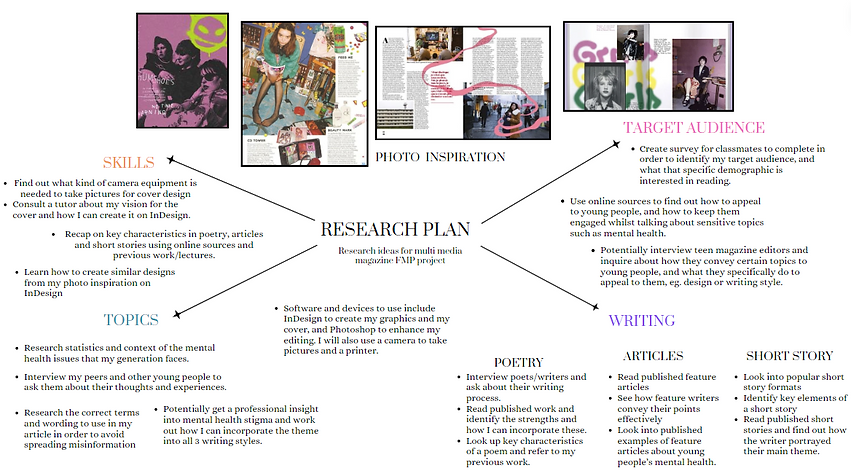
Below I have attached an image of my research plan in the form of a mind map. This helped me to organise my thoughts and ideas whilst categorising the different fields of research I need to conduct. I have also included some images of my inspiration regarding the design and cover of my magazine.
TARGET AUDIENCE RESEARCH
Target Audience Primary Research - Survey
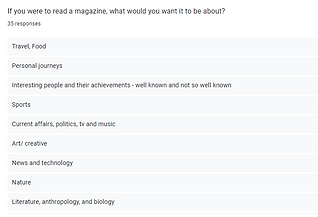
For my primary target audience research, I created an online survey on Google Forms. This helped me understand the main demographic of my audience (young people) and what they would be interested in reading about. Overall, I received 35 responses. Below I have included screen grabs of the results.




Responses to this question:
-
Concerned
-
Having grandchildren...Yes
-
I am passionate about mental health
-
I think it’s an important topic
-
Interested but not passionate
-
Kind of, I do seek to improve my own mental health as much as possible.
-
Not particularly, however willing to learn about it.
-
Not really, doesn't mean I don't think its important though
-
Of course - as someone who struggles with their mental health a lot I think it's very important to talk about.
-
Perhaps
-
Yes (x23)
-
Yes - they are our future
-
Yes - all my writing is about mental health.


Above are the responses to the survey I sent out. I sent this to a range of different people (in and outside of the college) and I ended up receiving 35 responses. The majority of my feedback consisted of people from my generation, which was ideal due to who I was aiming my magazine towards. Despite this, it was also helpful to receive answers from older generations as I found it interesting to identify the difference in responses and how I could possibly explore tweaking my work in order to appeal to a larger audience.
The most insightful question that I asked was whether anyone avoided reading content that talked about mental health, due to the stigma round the subject. The responses surprised me, as quite a few people said it would affect their interest and likeliness to read certain things. This made me determined to include subjects of young people's mental health in my work in a way that didn't come across as too factual/scientific or difficult to read.
Target Audience Secondary Research -
For my target audience secondary research, I decided to look at an existing magazine that inspired my own work, and identify their target audience. It is an online creative magazine called 'Teen Ink', which is a national teen magazine devoted entirely to teenage writing, art, photos, and forums. Teen Ink has offered teens the opportunity to publish their creative work and opinions on issues that affect their lives – everything from love and family to school, current events, and self-esteem. Hundreds of thousands of students, aged 13-19, have submitted their work to us and we have published more than 55,000 teens since 1989. I acquired this information from their website in the 'About Us' section. This initial set of statistics and information gave me a basic understanding of their target audience which is teenagers who are interested in being creative, specifically in art and literature.
After collecting this initial information, I decided I needed some feedback from Teen Ink's audience. To find this, I visited commonsensemedia.org, which is a website that allows parents and their kids to provide opinions on a range of media targeted at young people. Below are the results from each reviewed topic regarding this website:
-
Educational value: 4/5 Stars
-
Positive messages: 3/5 stars
-
violence and scariness: 1/5 Stars
-
Sex, Romance and Nudity: 1/5 stars
-
Language: 3/5 Stars
-
Drinking, drugs, and smoking: 2/5 stars
The star system indicates the amount of certain content within the magazine. These results are an overall range of opinions regarding the media and can be submitted by all ages, not specifically teenagers. This could cause a slight amount of bias when it comes to the thoughts of young people themselves, though could be helpful to identify difference in opinions in younger and older readers.

PRIMARY RESEARCH
The Beaney House of art and Knowledge
To begin the research for my project, a few of my classmates and I decided to take a trip to the Beaney House of art and Knowledge. This is an art museum located along Canterbury Highstreet. The reason for going to The Beaney was simply to find inspiration, as towards the beginning of the project we had little to no idea of the direction we wished to take it in – we went here in hopes of finding just one small thing that would spur on an idea.
.jpeg)
The museum contained a range of art and artifacts, alongside its own library which was filled with all kinds of literature from fiction to non-fiction. I found that scouting out different types of published work helped me to understand what kind of writing I wanted to include in my project.
.jpeg)
My friend in the Beaney Library
.jpeg)
Looking at some artwork in the gallery
.jpeg)
.jpeg)
Edvard Munch
Kunsthalle Tubingen (Madonna)
1977
Louis Icart
Art Deco
1920
.jpeg)
William Salter Herrick
'Annie Clara Dudley'
1888
Above were some of my favorite pieces I saw during our visit, specifically the different representations of women from different eras. Each piece conveyed a sense of knowledge and understanding, which is something I found inspiring when I was writing the poem 'A Fib in a Fable' for my magazine.
Talking to writers

For my next piece of primary research, we were provided with a range of insightful answers about writing, from author Claire Seebers. The questions revolved around the process of Claire's writing and how she found inspiration. I found these responses particularly helpful, as they refer to writing both novels and short stories. As I am including a short story in my magazine, I took this advice into account and implemented it into my own work. One specific piece of advice that I found the most intriguing was collecting ideas from a range of different sources in order to find inspiration. This is something that I am sometimes hesitant to do, as I like to have my own unique ideas, but I have since learned that pinpointing the effective pieces of writing in published work and using similar techniques in your own work can be extremely helpful and bring out your best writing.
Questions
-
Where do you gain your inspiration?
-
How did you develop your unique style/voice?
-
What you believe makes a good engaging writer?
-
What feedback have you received for your writing style and how have you incorporated this into writing?
-
Who are your influences? And how have they impacted you?
Answers
INSPIRATION:
I’ve heard it said many times now that writers are like magpies- I certainly collect things from all different sources and hide them away - in the old days I’d tear things out of newspapers and keep a file of them (still have them in fact), these days everything is online so I take screen shots of things I read (and then forget about them often!)
I’ve written mainly crime/ thrillers so keep an eye on the news for ideas. Fact is often stranger than fiction!
I use my phone notes and my voice memo app to record ideas sometimes because one thing I’ve learnt is if I don’t write it down, I’ll forget it in the next hour or 2! (and if you think of something in the middle of the night & don’t write it down, you def won’t remember in the morning!)
It’s a good idea to keep a notebook in your bag or pocket, I’d say, there’s something more creative about writing notes by hand, it might get the brain to flow better! And it’s also good for mental health, writing your thoughts down (I’m also a therapist)
I listen to the radio a lot and hear things on there, sometimes I’m watching a TV show or a film and it will give me an idea. Or go to an art gallery and look at paintings, they can be a really good source of inspiration, or photos – photojournalism or magazines.
If I’m writing a book, I often have pictures stuck up around me (again out of magazines, or postcards etc) that remind me of characters or settings. Or I’ll google a setting online, e.g. I wrote about a swanky villa in Ibiza last year, so I just looked up loads; I wrote about Oklahoma and the mountains, so I googled images.
Long train journeys are good for inspiration. Something about movement is good for the mind to get free!
And people watching, in a café, on a bus etc: My husband says I’m nosy, but I’m just fascinated by people, and also their conversations!
ASTER ASKS
How do you plan your stories? Do you usually start with characters, setting, plot or something else entirely when writing a new story?
For thrillers, I’d usually start with the idea, which is often placed in a setting already, and that would involve a couple of the characters too:
Eg in my book THE STREET PARTY I wanted to write about a community of mothers coming together to put on an event and then one teenager accusing another of doing something ‘bad’: did he or not? It was about the different classes in West London, ie some rich and upper-class, some working class, some middle class: how did they mix? What were the snobberies and unconscious biases? How did the different mums interact?
In my book THE STEPMOTHER I loosely based it on a modern Snow White story ie are all step-mums evil, like in fairy tales? (I’m one...I’m not evil honestly!)
So sometimes it’s the theme I’m interested in, i.e. in my book BAD FRIENDS, it’s about a TV producer who has just split from her boyfriend and is in an accident and then she starts being stalked by someone, is it someone from the TV world? I wanted to write about the moral responsibility of TV producers & who might get angry with them.
In a short story though, I might start with a character I want to write about. Or a historical event.
PLANNING:
I used to write one-page ideas and my editors would say go for it! And then I’d just start writing.
Now they’re more strict and make us write much longer synopses/ plans. It’s more competitive out there these days sadly. I do change things up as I write though, and I use a lot of post-it notes as I go along if I think of something new!
UNIQUE STYLE
Hmm good question!
I sort of hear voices in my head (I’m not completely mad though!), and I try to imagine how a character will speak. I studied drama and read a lot of plays and watched films, and that helped.
But if I’m writing in the 3rd person, I suppose I’ve just developed a style of my own over all these years of writing that has just evolved... I read loads – if you want to write, I’d say that’s VITAL!
Also writing loads and chucking it away as they say ‘Kill your darlings’ – you might think it’s great, a bit of writing you’ve done in a story, but if it doesn’t drive the action forward, you might have to bin that bit (or keep it for somewhere else!).
Read other people’s voices: try writing like them, then try seeing what your own voice says…experiment! Try different things: write short stories or just short scenes in first person voices.
FEEDBACK
I was a factual TV director first off (a researcher/ assistant producer etc first). I wrote little scripts for voice-over, or for comedy sketches for Comic Relief VTs etc. Then I also started writing features for the newspapers. I had to edit my features with feedback from my commissioning editor, so I got used to feedback.
In 2004, I did an evening class in fiction writing. We would write exercises or our own work at home, and then read it out and feed-back to each other.
It’s tough to feed back to others because people have such different tastes, so it’s important to focus on whether the piece of writing works, rather than if you like the subject matter etc. It’s important to choose something you like as well as something you think could may be worked on/ be better. I taught Short story writing at Greenwich University and often it would be obvious what worked and what didn’t: some students found it hard to accept any constructive criticism: if you become published, your editor will ask for edits though. So don’t be really defensive. Try and listen to feedback.
When I first started being published in 2007, Amazon had only just started, and online / social media wasn’t a thing. It’s got tougher and tougher as the publishers have evolved into digital publishing, and have relied heavily on online reviews - and that’s often not feedback, it can just be cruel or vicious, or people have their own agenda, or are competing writers etc; or people will give 1 star because ‘it’s not the book I ordered’ etc. Star rating has a huge effect on sales etc.
I know some writers – JoJo Moyes is one - who read all her reviews when she wasn’t selling well at all. She started to take note that people were saying ‘too slow to start the story’ etc and she changed her style. Now she’s a massive best seller, so I guess it can work.
However, in some genres of writing, reviewers are more harsh than others! (psych thrillers/ crime can be very harsh, they seem to read A LOT and they have come to expect a formula etc!)
I have taken notice occasionally of fiction reviews if everyone says the same thing, but I think the biggest point I notice is how one person can love a book whilst another might hate it: it’s so personal!
GOOD ENGAGING WRITERS
Have something to say about the world. They don’t just subscribe to ‘tropes’ or formulas. Or they turn them on their head.
They might have a different outlook, maybe, on an issue, rather than the ‘typical’ outlook.
Or are good at creating believable characters and their internal worlds: ie why someone does something; that’s important to me. To be convincing, even if it is far-fetched, are the character’s actions convincing even if they are in an extraordinary situation?
Good writers don’t over-explain, the ‘less is more’ motto can be true: show, don’t tell J
It’s hard at first to get this right, try setting a scene by describing the person’s mood being reflected by the weather, or how they’re sitting or walking, or the tension in a room etc, rather than explaining every single thing that’s going on. Let the reader do some work!
And don’t write too much, very long books often could use a good edit!
MY INFLUENCES
What is your favourite thriller story/author? And Why?
For the kinds of books I’ve written, probably Daphne Du Maurier’s Rebecca: a book about a new (2nd) marriage and the new wife being haunted by the idea of the husband’s dead wife, who seems to have been perfect. Was she though? I read it when I was 17 and stayed up all night reading it!
I used to like a writer called Nicci French, who wrote books a bit like the ones I went onto write: strong female protagonists caught up in a problem / crime/ bad relationship etc.
I like a good mystery that keeps you guessing and that is convincing when you find out the truth – as a kid, I loved Agatha Christie. (And Scooby Doo J not sure they were convincing plots though!)
I read really widely, though, across genres, and I think that’s important because it’s a cheap way of learning your craft.
Nowadays my favourite thriller writers are:
The ones mentioned above, also:
I quite like Janice Hallett – she’s a screenwriter who writes her thrillers/ mysteries in a pretty original/ different way i.e. all in emails etc.
Gillian Flynn, who wrote Gone Girl -her first book: Sharp Objects (it’s now an HBO series too, but not as good as the book)
Lisa Jewell is beloved in the UK crime writer family, I think it’s because she writes worlds people want to live in, rather than brilliant plots!
STRUCTURE
Do you use any plot theories (like save the cat) to structure your work or do you have your own process?
Ha! I don’t think Save the Cat existed when I started out! So no, though I do remember a lot of talk about ‘there’s only seven stories’ in the world, or the 3-act structure.
I would probably adhere to the Problem/ Conflict/ Resolution idea of a narrative arc.
Having made documentaries for years, I was always big – and this might sound funny – on the idea of ‘start, middle and end’ – and how to get your viewer/ reader to come back after the advert break! There were the cliff-hangers to do that…(you can see it in reality TV e.g. MAFS, they’ll tease you at the start and during the show with a bit of conflict etc. )
Editors now will talk about ‘hitting the beats’. It’s become very formulaic in the world of psych thrillers, sadly.
How many drafts do you typically write before you deem your manuscript finished?
Depends on how long I’ve got! Sometimes I’ve had to write a book in 8 weeks under contract. Not ideal! Probably one or 2 if it’s commissioned, then send it to agent/ editor, then the editor will send structural edits (there’s lots of rounds of edits) but the first are the biggest usually, if something doesn’t work in the story. So that’s the 2nd or 3rd draft…I’d always advise printing your work out and reading it on paper before doing edits/ re-drafts. It looks different on the page than on the screen.
I’ve got another book coming out late this year, a historical spy thriller set between WWI & WWII & it took me about five years to get it to the point of my then-agent thinking it was ready to send out to publishers, and another eight years to get it to the point of publication!! (It was much too long originally, 700 pages +!)
What is your favourite part of writing a story?
I have to come back to this: It’s hard!
Off top of my head, I like a scene full of sexual tension! I like writing dialogue I like a bit of humour too.
I love writing family relationships: sibling rivalry etc.
What was the process of becoming published, what challenges did you face?
I was really lucky I realise now, I didn’t at the time! I wrote the book LULLABY (my first psychological thriller about a baby going missing on a day trip to the Tate Modern) in 2004-2005, and then I looked at the Writers & Artists Yearbook (now online, though think you have to subscribe). I chose the agents who repped books in my ‘genre’ (& sadly, publishing is OBSESSED with genre and putting everyone in a pigeon-hole, or copying whoever is doing well, i.e. Richard Osman’s cosy crime, look at other covers of cosy crime, they’ll all look similar!) …and I started looking for agents in that book at A and worked my way through – originally I sent out my first 3 chapters to five agents. 2 were interested. One wanted to read the whole lot, and I signed with her. MY advice to myself now would have been – Stop! Send it to more, and meet more agents! Then decide, if there is an option! Choosing an agent, if that’s the route you go down, is like dating. Don’t be sucked in by someone who actually hasn’t got your best interest at heart etc, or who you realise later on you don’t get on with. Find out what they’re going to do for you, don’t just be ‘grateful!’ in theory the agent works for you i.e. they make money off your ‘product’. That said, don’t be full of ego either! Be humble!
That first agent asked me to make a few changes to the manuscript. I was happy to do that: then she sent it out, and it sold in Holland on the first day. Then it sold to Harper Collins within 6 weeks. Now I realise that was super quick and lucky.
Crime used to be the biggest selling genre, so I chose crime because I wanted to earn money to feed my baby! But now it might be ‘Romantasy’, thanks to TikTok!
Do you have advice for new writers going through publishing for the first time?
Stay strong! It’s hard. Ask questions. See if you can bring something a bit unique to the table – what people like to call a USP! Go to the place that will publish someone like you.
These days people self-publish a lot more, thanks to Amazon (I hate Amazon for reasons I won’t go into now!) so it’s easier to do than it was when I started. And publishers are looking for more diverse voices these days.
But also write what you want to write. Don’t write something completely cynically because it will probably show.
And from Antony – who is exploring the thriller genre.
If you like thrillers, Antony, maybe read Stephen King’s book on how to write, it’s meant to be great! (can’t remember the name of it sorry)
Where do you typically get the inspiration for your stories and what's your method to evolve these ideas into stories?
See above answers re inspiration...
To evolve: do a mind map of your idea. Write a plot line/ synopsis and break it down into scenes and acts. Talk to your mate or your mum etc about your idea, get feedback. Sometimes my husband (or my sister!) who are teachers, not writers, will suggest something when I’m stuck and it helps!
What do you enjoy about the Thriller Genre and why do you write it?
I like plot!!
I like page turners myself, and I like to be kept guessing…I want to feel like I’m working something out as a reader, so that’s what I want to do as a writer.
I want the writing to feel urgent enough to bring the reader back to it.
Trip to Oxford Brookes
Another piece of primary research I conducted was during a trip to Oxford with my family. During this trip, we visited Oxford Brookes University, due to my interest in their Journalism course. I took this opportunity to conduct some research.

During a talk about the course from a Journalism, print, and media lecturer, I decided to interview a student about the work they were doing, specifically writing feature articles. As I am including a feature in my magazine, I thought this information would be interesting and helpful during my creative journey.
Below I have included the questions I asked a student called Emma, and her responses:
-
What do you think makes a good feature article?
Personally, when I am writing a feature I try to engage the reader's emotions or interests quickly and reward them for reading. Keeping in mind your audience is also key.
-
How do you identify your specific audience?
I try to stick to something somewhat niche to write about - having a specific topic and sticking to it maintains engagement for a specific audience and keeps them interested
-
Do you find news articles or feature articles more interesting to write?
They both have their key differences, specifically when it comes to timing and language. I personally prefer to focus on a specific topic and zoom in on it, which is why feature writing is often something that piques my interest more.
-
If you had to give one piece of advice for a student writing a feature article, what would it be?
A captivating story is one of the most important things to keep in mind. No one wants to read about something vague and uninteresting as it appeals to no one. Try to spark emotion in your piece and make sure you have conducted relevant information such as statistics and interviews to support your points.
.jpeg)
Students I talked to about Journalism and producing work.
.jpeg)
.jpeg)
Open Day talk from University Lecturers
Published/printed work from the Journalism and media department
Oxford Brookes University. (n.d.). It’s time to discover. [online] Available at: https://www.brookes.ac.uk/study/c/its-time-to-discover?gad_source=1&gclid=Cj0KCQjw0ruyBhDuARIsANSZ3wqMYPw9ZMw5hnpMm4pWCTPl9IoGvKJPE-UV-hbKSom1F99UTLN1YVsaAsx8EALw_wcB&gclsrc=aw.ds [Accessed 23 May 2024].
Oxford Brookes University. (n.d.). Communication, Media, Journalism and Publishing. [online] Available at: https://www.brookes.ac.uk/study/subject-areas/communication-media-journalism-and-publishing [Accessed 23 May 2024].
Oxford Brookes University. (n.d.). Open Days and Events. [online] Available at: https://www.brookes.ac.uk/open-days [Accessed 23 May 2024].
Photography
An important aspect within my magazine is the use of images and photographs to display examples and visually demonstrate the theme of each piece of writing. This is why I decided to practice taking photos using my iPhone and identify ways to enhance the pictures using editing. Below I have attached some of my first attempts at photography that I could possibly include in my magazine.
Below I have included a link to see some of the photos that I took and experimented with.
SECONDARY RESEARCH
Visual design
To begin my research for the design of my magazine, I decided to research some magazines that had certain design aspects that inspired me. Below I have attatched some images of my initial inspiration.
.jpeg)
.jpeg)
.jpeg)
.jpeg)
.jpeg)
.jpeg)
.jpeg)
I specifically liked the bold, warm colours in all of these designs. I felt like these could attract my target audience of young people as they are attention grabbing and colourful, as well as having a maximalist style that includes a range of images to catch the eye of viewers. I found that most of these designs inclused shapes and tet wrap which added a unique flare. This is something that I researched how to achieve on canva and Indesign and attempted to replicate on my own magazine.
I researched online to find ways to accentuate a magazine design, and implemented these skills. Below I have attached the websites that I looked at:
https://www.domestika.org/en/courses/3960-magazine-design-how-to-create-impactful-layouts?
https://www.toastdesign.co.uk/magazine-design-articles/10-tips-for-designing-magazines/
Subject/topic
As the main themes of my magazine revolve around young people's mental health, I decided to do some research on this subject. The specific areas I decided to look into were:
-
Why Gen-Z's mental health seems to be a bigger issue than other generations
-
Are there any contributing factors to the decline of young people's healthy minds
-
What are some ways that society can tackle this ongoing issue
-
Could the future of this generation be affected by poor mental health?
Below I have attached links to the sources that aided me in my research:
-
YoungMinds. (n.d.). Mental Health Support For Young People. [online] Available at: https://www.youngminds.org.uk/young-person/.
-
Mind (2023). Facts and figures about young people and mental health. [online] www.mind.org.uk. Available at: https://www.mind.org.uk/about-us/our-strategy/doing-more-for-young-people/facts-and-figures-about-young-people-and-mental-health/.
-
www.uhc.com. (n.d.). Tips to help protect your child’s mental health from harmful social media use. [online] Available at: https://www.uhc.com/news-articles/healthy-living/social-media-mental-health??Source=GA&gad_source=1&gclid=Cj0KCQjw0ruyBhDuARIsANSZ3wpioi3GT1wS_uvq0ydlm6IL1ZAMHVlr_WGqU9Fh8IoIgG0kq4Zno2saAsJyEALw_wcB [Accessed 23 May 2024].
-
Macmillan, A. (2023). 4 Reasons for the Increase in Mental Health Conditions. [online] Health. Available at: https://www.health.com/condition/depression/8-million-americans-psychological-distress#:~:text=Mental%20health%20disorders%20have%20risen.
-
Anwar, B. (2021). Why is Mental Health Important? [online] Talkspace. Available at: https://www.talkspace.com/blog/why-is-mental-health-important/.

The image on the left is a summary of the research I acquired surrounding young people's mental health. My findings have helped me to gain a better understanding of the topic my project revolves around and is particularly helpful when writing any kind of journalistic writing I include in my magazine, such as feature articles.

Analysing magazines
For this piece of secondary research, I decided to analyse the Online literary magazine for teenagers, called 'Teen Ink'
I used this magazine as an example for my target audience research, but due to my intruige and inspiration from this online magazine, I decided to analyse it and identify the key elements and wjhat makes it so engaging.
Teen Ink is a well-known literary magazine and website that features the writing, art, and photos of teenagers aged 13-19. The publication provides a platform for young people to express themselves creatively and share their perspectives on a wide range of topics such as personal experiences, social issues, relationships, and more. Below I have detailed some key elements:
Platform for Teen Expression
Teen Ink allows teenagers to showcase their creative work, including poetry, fiction, non-fiction, and artwork. It provides a space for young writers and artists to have their voices heard and their talents recognized.has context menu
Community and Suppourt
The magazine fosters a sense of community among young writers and artists, offering them the opportunity to connect with peers who share similar interests and passions. This can be especially valuable for teenagers who may feel isolated or misunderstood in their immediate environments.
Diversity of Perspectives
The magazine features a diverse range of voices and perspectives, reflecting the experiences and concerns of teenagers from various backgrounds and cultures. This diversity enriches the content of the magazine and allows readers to gain insights into different lived experiences.
Recognition
Teen Ink gives teenagers the chance to see their work published in a respected magazine and website, providing validation and encouragement for their creative endeavors. This can boost their confidence and inspire them to continue exploring their artistic talents.
Educational Opportunities
Teen Ink also provides educational resources and opportunities for young writers to develop their skills and learn more about the craft of writing and art. This can help aspiring young artists and writers to improve their abilities and pursue their creative interests further.

Overall, Teen Ink plays an important role in promoting creativity, self-expression, and community among teenagers, and it serves as a valuable platform for young writers and artists to share their work with a wider audience.
FINDINGS
I created a short online survey in order to identify my target audience, what they would like to see in a magazine, and whether they would be interested in reading about mental health in Gen-Z. I sent this survey to people of all ages, as I deemed it important to have a wide range of opinions from a vast age range, even if my magazine was primarily intended for young people. This piece of research allowed me to gain a greater understanding of what young people would like to read and the best way to convey important information without it coming across as dull.
I asked the following questions:
-
What generation do you belong to?
-
If you were to read a magazine, what would you want it to be about?
-
Are you interested/passionate about young people's mental health?
-
If so, why do you think it is an important subject to speak about?
-
What style of writing are you most interested in reading?
-
What do you think is the most popular source of current events/news for your generation?
-
Do you believe that the stigma around talking about mental health affects whether you want to read about it?
I ended up receiving 35 responses. The majority of my feedback consisted of people from my generation, which was ideal due to who I was aiming my magazine towards. Despite this, it was also helpful to receive answers from older generations as I found it interesting to identify the difference in responses and how I could possibly explore tweaking my work in order to appeal to a larger audience.
The most insightful question that I asked was whether anyone avoided reading content that talked about mental health, due to the stigma around the subject. The responses surprised me, as quite a few people said it would affect their interest and likeliness to read certain things. This made me determined to include subjects of young people's mental health in my work in a way that didn't come across as too factual/scientific or difficult to read.
My second part of target audience research involved looking at an existing magazine that inspired my own work, and identify their target audience. It is an online creative magazine called 'Teen Ink', which is a national teen magazine devoted entirely to teenage writing, art, photos, and forums.
I visited commonsensemedia.org, which is a website that allows parents and their kids to provide opinions on a range of media targeted at young people. Below are the results from each reviewed topic regarding this website:
-
Educational value: 4/5 Stars
-
Positive messages: 3/5 stars
-
violence and scariness: 1/5 Stars
-
Sex, Romance and Nudity: 1/5 stars
-
Language: 3/5 Stars
-
Drinking, drugs, and smoking: 2/5 stars
The star system indicates the amount of certain content within the magazine. These results are an overall range of opinions regarding the media and can be submitted by all ages, not specifically teenagers. This could cause a slight amount of bias when it comes to the thoughts of young people themselves, though could be helpful to identify difference in opinions in younger and older readers.
My next piece of research was a visit to the Beaney House of Art and Knowledge.
The museum contained a range of art and artifacts, alongside its own library which was filled with all kinds of literature from fiction to non-fiction. I found that scouting out different types of published work helped me to understand what kind of writing I wanted to include in my project.
For my next piece of primary research, we were provided with a range of insightful answers about writing, from author Claire Seebers. The questions revolved around the process of Claire's writing and how she found inspiration. I found these responses particularly helpful, as they refer to writing both novels and short stories. As I am including a short story in my magazine, I took this advice into account and implemented it into my own work. One specific piece of advice that I found the most intriguing was collecting ideas from a range of different sources in order to find inspiration. This is something that I am sometimes hesitant to do, as I like to have my own unique ideas, but I have since learned that pinpointing the effective pieces of writing in published work and using similar techniques in your own work can be extremely helpful and bring out your best writing.
Another piece of primary research I conducted was during a trip to Oxford with my family. During this trip, we visited Oxford Brookes University, due to my interest in their Journalism course. I took this opportunity to conduct some research. I asked a media student some questions about how to write a feature article and I have attached the answers to my questions below.
-
What do you think makes a good feature article?
Personally, when I am writing a feature I try to engage the reader's emotions or interests quickly and reward them for reading. Keeping in mind your audience is also key.
-
How do you identify your specific audience?
I try to stick to something somewhat niche to write about - having a specific topic and sticking to it maintains engagement for a specific audience and keeps them interested
-
Do you find news articles or feature articles more interesting to write?
They both have their key differences, specifically when it comes to timing and language. I personally prefer to focus on a specific topic and zoom in on it, which is why feature writing is often something that piques my interest more.
-
If you had to give one piece of advice for a student writing a feature article, what would it be?
A captivating story is one of the most important things to keep in mind. No one wants to read about something vague and uninteresting as it appeals to no one. Try to spark emotion in your piece and make sure you have conducted relevant information such as statistics and interviews to support your points.